





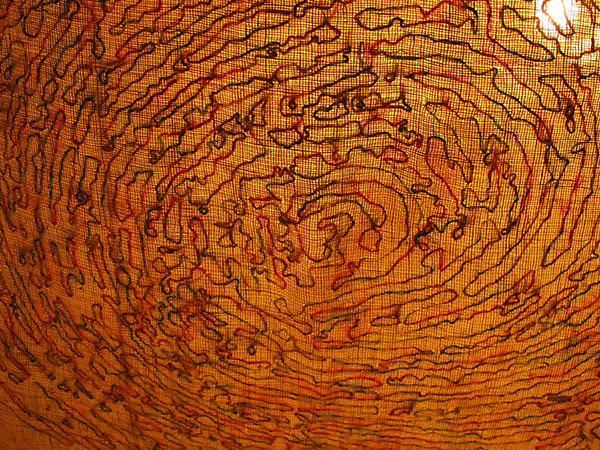


Please see footnotes below for accessibility descriptions of the artworks:
- The image depicts a red, abstract, textured piece of art. It features a large canvas draped with red fabric that has been arranged in a flowing, organic, and dynamic manner. The fabric, with glittering or shiny elements, creates a sense of movement and depth across the canvas. Several small, red, butterfly-like shapes are pinned or attached to various points of the fabric, adding a delicate and ornamental touch. The fabric seems to emanate from a central point, where there is a circular object that draws focus.
The backdrop of the canvas has a dark red and purple colour, with hints of blue and other hues blended into the background. There’s a more muted, abstract quality to this painted backdrop, contrasting the vibrant, eye-catching red fabric.
In the lower right corner, there appears to be a signature or symbol marked with the letters ‘T over M.’
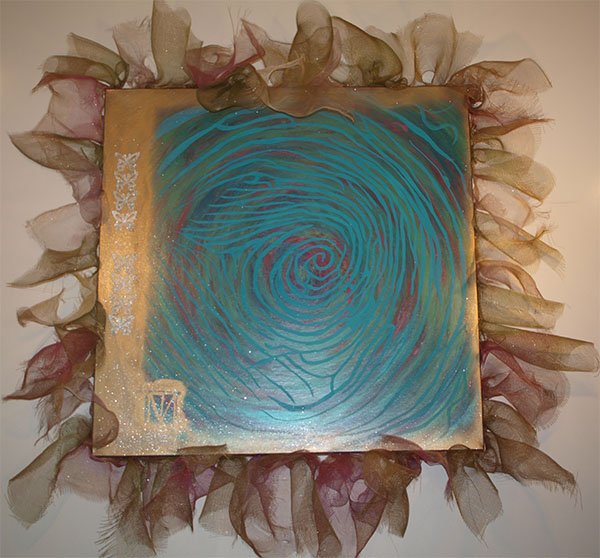
The artwork is placed outdoors, with natural green plants surrounding the lower and side areas, further enhancing the organic feel of the composition. ↩︎ - This image shows a square canvas with an abstract, swirling pattern at the centre. The main feature of the artwork is a turquoise spiral, resembling a fingerprint, which seems to swirl inwards, creating a sense of depth and movement. The spiral is composed of fine lines that gradually tighten as they move toward the centre, forming concentric rings. The colours within the spiral transition from turquoise to hints of purple and red, creating a subtle, layered effect.
Surrounding the canvas is a border of sheer, wavy fabric in soft colours such as beige, brown, and pink. These fabric pieces are gently gathered and arranged around the edge of the canvas, creating a three-dimensional, floral-like frame that extends outward from the artwork. The use of fabric adds texture and an organic feel to the piece, contrasting with the smooth, swirling lines of the spiral.
On the left side of the canvas, there are delicate symbols or figures painted in white. These may represent abstract shapes, butterflies, or characters, though their exact meaning is unclear. In the lower-left corner, there appears to be the same “M” signature or symbol that was present in the other artwork, suggesting the artist’s mark.
The background of the canvas is a soft gold, and it shimmers slightly, adding a reflective quality to the artwork. The combination of the spiral, fabric border, and shimmering background gives the piece a meditative, calming energy. ↩︎ - This image shows an abstract, vibrant painting filled with colourful, circular spiral patterns. The spirals are composed of small, dotted points that alternate between shades of blue, orange, pink, and white. These dots create intricate, swirling shapes that radiate outward from various central points across the canvas.
The background features warm hues of orange, yellow, and ochre, giving the image an earthy, glowing feel. These colours blend together in a smooth, gradient-like fashion, suggesting the texture of sand or a desert landscape. The spirals are surrounded by darker brush strokes, possibly in black or deep brown, which create a sense of contrast and movement, as if these swirling shapes are pulsating or emanating energy from the canvas.
The overall impression is organic and dynamic, reminiscent of traditional Indigenous Australian dot painting techniques or other cultural art forms that emphasise repetition and circular patterns. The artwork feels rhythmic and alive, with the dotted spirals and warm background invoking a sense of connection to natural elements like the earth or celestial bodies. ↩︎ - This artwork is a striking composition dominated by deep shades of blue. The central focus is a series of concentric, circular brush strokes that seem to swirl inward, creating a hypnotic, vortex-like effect. The swirling lines of blue range from darker, almost navy tones at the outer edges to brighter, electric blue hues closer to the centre, giving the painting a sense of depth and motion.
Scattered across the canvas are small, rectangular and oval cut-outs. These cut-outs are irregularly spaced and provide glimpses of the background or light behind the canvas, adding an extra layer of texture and dimensionality. The cut-outs reveal small flashes of contrasting colours, possibly golden or yellowish tones, further breaking up the uniformity of the blue surface and creating a sense of mystery or curiosity as to what lies beyond the openings.
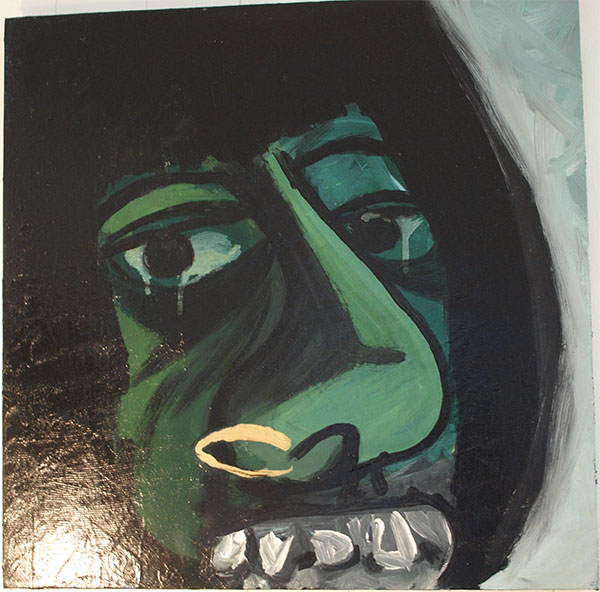
The background and overall colour scheme give a cool, serene feeling, but the cut-outs and swirling pattern introduce an element of intrigue. The painting has a minimalist yet dynamic quality, with the simple use of colour and pattern creating an immersive visual experience. ↩︎ - This image depicts a close-up, abstract portrait of a face. The painting uses dark, moody tones, primarily greens and blacks, to create a dramatic and somewhat unsettling expression. The face fills most of the canvas, with an exaggerated and distorted appearance.
The eyes are large and seem slightly asymmetrical. The left eye (on the viewer’s right) has a droopy, melancholic expression, while the right eye (on the viewer’s left) appears more open, though both eyes seem to stare directly at the viewer. Dark lines under the eyes give the impression of tears or exhaustion.
The nose is prominent, with bold shading in various shades of green, giving it a sculptural quality. The mouth is slightly open, showing a set of roughly outlined teeth. The teeth are painted in white, with the lower lip highlighted in a way that makes the expression appear tense or grimacing.
The left side of the face (on the viewer’s right) is primarily painted in dark green and black, creating deep shadows that give the face a three-dimensional, almost carved look. The background, especially on the right side of the canvas, is lighter, with swirls of grey and white paint that seem to contrast with the intensity of the face.
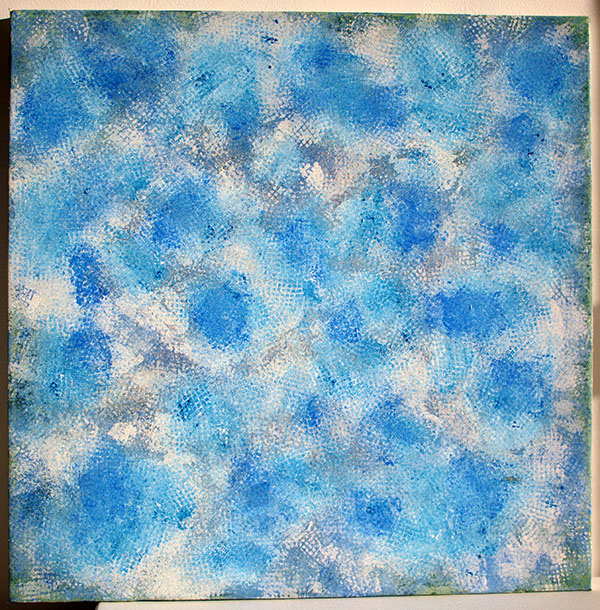
Overall, the portrait evokes feelings of discomfort or sadness, with the use of dark, muted colours and exaggerated features contributing to the intense, emotional impact of the artwork. ↩︎ - This artwork features a soft, abstract texture of blues and whites. The entire canvas is covered in a pattern resembling clouds or ripples of water. Various shades of blue dominate the composition, from light sky blue to deeper oceanic tones. These hues are interspersed with areas of white, creating a soft, blended effect that makes the colours appear to gently bleed into one another.
The texture on the surface has a subtle grid or mesh-like pattern, almost as if a textured material has been pressed into the paint to create small, repeated marks. This gives the artwork a tactile feel, as though the surface would have a slight roughness to the touch.
The overall effect is calming and ethereal, with the diffused blues and whites evoking the feel of looking up at a clear sky or down at the reflection of the sky on the surface of the water. It feels peaceful and expansive, allowing the viewer to get lost in its tranquil atmosphere. ↩︎ - This artwork can be described as a mixed-media piece where a layer of coral paint has been intentionally peeled off from another surface and then applied or overlaid onto a painted background. The coral-coloured layer, now fragmented, creates jagged, irregular openings through which the vibrant blue and white painted surface beneath is revealed.
The coral layer appears to have been manipulated to show torn or broken edges, emphasising the contrast between the flat, smooth pink surface and the dynamic, textured layer beneath. The underlying surface, with its swirling blue tones and white accents, feels fluid and energetic, almost like water or abstract forms, while the coral layer on top acts like a mask, partially concealing and revealing the energy beneath. The peeled-off quality of the coral paint adds a sense of rawness and deconstruction, making the piece feel as though it’s in a state of transformation or exposure.
This interaction between the two layers gives the artwork a tactile, layered appearance that invites the viewer to think about processes of uncovering, layering, and perhaps even destruction and reconstruction. The juxtaposition of vibrant blue and coral red creates a bold visual impact, further enhanced by the textural interplay of the materials used. ↩︎
 T Lee Meads
You must be logged in to post a comment.